
Disclosure: some links in this article are affiliate links. If you buy through them, I may earn a commission at no extra cost to you. My opinions are my own, including the parts where I disagree with the course.
Looking for my full overview of CXL courses? Read the main article: CXL Institute courses review.
Six months ago I built servisko.online, a small directory of repair technicians in Serbia, as a testing ground for programmatic SEO. Today it has 604 clicks and 33,000 impressions from Google Search, and traffic keeps growing month after month.
I built the site using the principles from an on-page SEO course, the first one I bought in a long time and decided to review. I have been doing SEO for 16 years, and programmatic SEO is a topic that gets very little coverage in my market, even though some of the biggest SEO teams in the world rely on it.
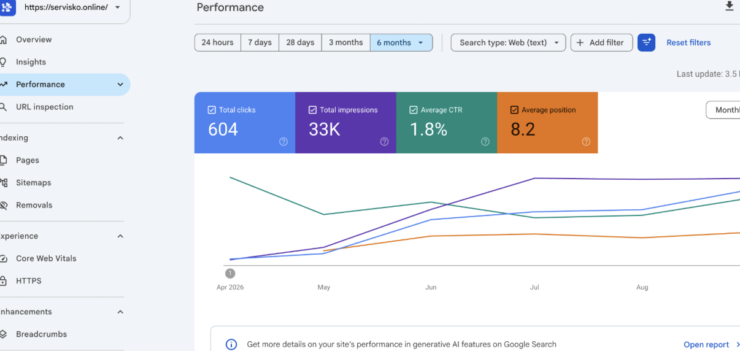
I applied most of the course. Some of it works very well, some of it does not hold equally for small and large players, and some of it behaves differently on the Serbian market than on the American market the course was written for. Below is what was worth it and what was not.
Contents
Quick verdict
My score: 8/10. A strong framework and a practical set of processes, written mainly for large brands and the US market. Best for beginner to intermediate SEOs, in-house marketers and content teams. Less useful if you already run advanced technical SEO and link building.
Course at a glance
| Course | On-Page, On-Site & Programmatic SEO (CXL) |
| Length | 2h 02min, 12 lessons, 5 downloadable resources |
| Instructor | Logan Bryant |
| Format | On-demand video, English subtitles |
| Certificate | Included. Final exam requires 90% or higher; you can retake after 6 hours. |
| Topics | Content quality, AI and E-E-A-T, SERP analysis and briefs, topic clusters, internal linking, SEO testing, programmatic SEO, international SEO |
What the course covers
The course goes from content quality to scaling:
- What on-site SEO encompasses. Content as the first lever, internal linking as the second.
- AI and helpful content. Where AI is safe and where it is risky.
- E-E-A-T and YMYL. Authors, sources, About and Contact pages, reviews.
- Leveling up content quality. Entities, information gain, direct writing, topical authority.
- SERP analysis and content briefs, plus a bonus walkthrough of a brief template.
- Topic clustering and information architecture. Hub and spoke, crawl depth, orphan pages.
- Internal linking. The “Robin Hood” method.
- SEO testing and content refreshes.
- Programmatic SEO. A 10-step framework.
- International and multilingual SEO.
Content as the main lever: true, but not for everyone
The claim that content is the strongest SEO lever, with internal linking right behind it, is repeated everywhere. For mature sites with authority it mostly holds: when a domain already has trust and links, every new quality page has something to build on.
Where I disagree
For a new or small site the order is different. With no quality links and technical problems (indexing, speed, weak structure), an excellent article simply does not get a chance. At the start the best investments are:
- A technical foundation (indexing, canonical tags, sitemap, mobile speed),
- The first few links and mentions from relevant sources,
- Only then content expansion.
The value of each investment changes with business maturity: the bigger and stronger the site, the more of the result content carries, and the less links and technical work do. So “just write more and better” is, for a client without authority, often an expensive way to wait.
Practical takeaway
Before telling a client they need content, check three things: are the key pages indexed, do a few external links point to them, and are the target keywords realistic for the domain’s current authority. If the answer is no, content is not step one.
AI content and Helpful Content: where the real line is
Google has publicly said it cares less about how content is produced than whether it is useful to people. Two opposite and equally wrong conclusions follow: “AI is banned” and “AI is completely safe.”
What is reasonable
AI is safest where a mistake costs little: meta titles and descriptions, content brief drafts, keyword clustering, internal link suggestions, and first drafts that a human genuinely rewrites. Risk grows when content is published without review, in bulk, and without anything original in it.
Where I disagree
Splitting things into “safe zones” and “dangerous zones” is too simple. The real problem is not the tool, it is the absence of experience and of information others do not have. A human-written article that retells the top ten results is no better than an AI article that does the same. A better question than “did AI write it?” is “what does this page contain that is not in the top 10?”
Also read the rules through Google’s policy against scaled low-quality content. It targets volume without value, whether it is produced by AI, people or a mix.
Practical takeaway
Automate preparation (research, structure, checks), not what makes a page valuable: experience, data, examples and expert review.
E-E-A-T and YMYL: a useful checklist, not a ranking factor
E-E-A-T (experience, expertise, authoritativeness, trust) comes from Google’s quality rater guidelines. YMYL topics can affect a reader’s health, money or safety: medicine, finance, law, news. In those niches Google expects a higher level of trust.
What you can do
- A named author with a bio and profile links,
- A reviewer or expert who confirms the content,
- A last-updated date and a visible review process,
- Cited primary sources (institutions, studies, regulations),
- A clear About page and contact details, real reviews, press mentions.
Where I disagree
E-E-A-T is not a number you can optimize. None of these elements raises rankings on its own. They are signals raters look for, and the algorithm evaluates them indirectly. Adding a byline and a “reviewed by” label without real expertise is cosmetics, and in health it can be misleading.
The claim that E-E-A-T is “mostly based on links and mentions” is also a simplification. Links and mentions are part of the picture, but what shows experience (original photos, your own data, concrete examples) matters just as much, and small sites can produce exactly that.
Practical takeaway
For health and other YMYL clients, make sure a qualified person actually reviews the text and is credited by their real name. Do not write “reviewed by an expert” if it is not true.
SERP analysis and the “perfect page”: copying is not information gain
A good writing process starts with the results page, not a blank document. You look at search intent, the type of pages that rank (guide, “best” list, brand homepage), featured snippets, “People also ask”, autosuggest, the titles of the top results, and the strength of competitors’ domains and links.
What is good about this approach
You first decide whether you can compete at all. If the top 10 are domains with hundreds of referring domains and you have a handful, writing a “better” article is the wrong keyword choice, not a bad article. Then you collect the elements that repeat (table of contents with jump links, a short summary at the top, a comparison table, a diagram, an FAQ) and build a brief and an outline.
Where I disagree
Collecting “the best ideas from the top 10” leads to homogenization: everyone assembles the same page from the same parts. That is the opposite of the stated goal, which is to add what others do not have. Elements everyone has (a table, a contents list, a TL;DR) are the entry ticket, not a reason for Google to prefer you.
The real difference comes from what top-10 analysis does not give you:
- your own data, measurements, surveys or screenshots from practice,
- an angle that no result covers (a real “hidden intent”),
- concrete steps someone has actually followed,
- precision where the others only generalize.
Competitor word count is also only a rough range. A longer text does not rank because it is longer.
Practical takeaway
After the competitor analysis, write a list called “what none of them say.” If the list is empty, the keyword probably is not for you.
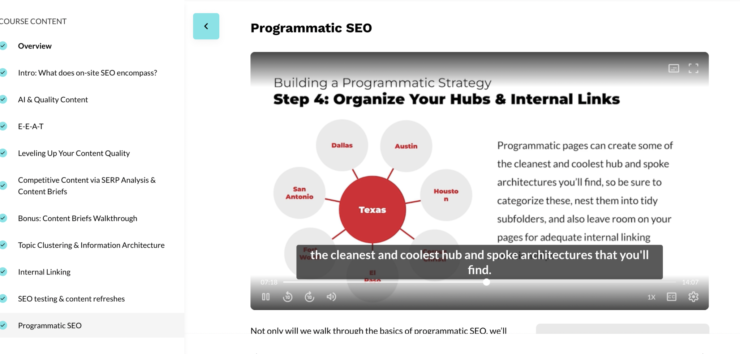
Hub and spoke architecture, crawl depth and orphan pages
The idea is simple: one main page (the hub) covers a broad topic, and more detailed pages (spokes) are grouped around it and linked together. Three levels are often mixed up: keyword clusters, topic clusters and URL clusters.
What is right
- The structure Google understands comes from links between pages, not from how folders are nested.
- The closer a page is to the homepage (fewer clicks), the easier it is to discover and the more strength it gets. So flatter is better than deeper whenever possible.
- An orphan page (no internal links) is practically invisible for SEO.
Where I disagree
The claim that URL structure has “no significant impact” is acceptable for ranking, but it ignores practical reasons: a readable URL makes analysis in Search Console, report segmentation and duplicate control easier. A consistent folder logic is cheap and helps you, even if it did not help Google.
The advice on navigation has a similar problem. Putting as many links as possible in the menu to “flatten” the architecture has a cost: too many links dilute the value of each one and hurt user experience. On a webshop with hundreds of categories it is better to group clearly and add contextual links.
Finally, the difference between subdomains and subdirectories is often exaggerated. A subdirectory is usually the simpler choice, but a well-managed subdomain is not a fatal mistake.
Practical takeaway
Export a crawl (Screaming Frog or similar), find pages deeper than three clicks and all pages with no incoming links. That is the fastest architecture audit.
Internal linking and the “Robin Hood” strategy
Internal links are the one lever you fully control. The strategy known as “Robin Hood” has three steps: list the pages you want to lift (money pages and stagnating pages), export the pages with the most referring domains, and link from the second group to the first, paying attention to relevance.
What is good
The idea is simple and quick to apply. Pages that earned external links (often old guides or research) are usually not the ones that bring revenue, so it makes sense to connect them to the pages that sell. Programmatic “related articles” modules solve the problem of large sites where manual linking is impossible.
Where I disagree
- The “juice” metaphor is overstated. An internal link helps discovery and gives context through anchor text. The idea that “strength” flows from one page into another is not mechanically predictable. Do not expect a jump just because you added a link from a strong page.
- Relevance matters more than strength. A link from a page with many links on an unrelated topic gives little and can confuse.
- Too many links on one page reduce the weight of each and make the text hard to read.
- Link position (higher in the text is worth more, tabs and accordions less) is a reasonable assumption, but not a rule Google has confirmed. Treat it as a hypothesis you test.
- Anchor text should be natural and descriptive, not always an exact-match keyword.
Practical takeaway
Build a table: target page, 3 to 5 relevant source pages with the most links, suggested anchor. Apply them and track changes in Search Console over 4 to 8 weeks.
SEO testing and content refreshes: do not call a hypothesis proof
Most “optimizations” are really hypotheses: we do A and expect B. It is honest to treat them that way: record the starting point, make the change, measure the result. The simplest form is a time-based test in Search Console. For a content refresh that means: pick pages that are declining, record rankings and 90 days of traffic, write a new brief, publish, resubmit the URL for indexing, and compare after 4 to 13 weeks.
Where I disagree
A time-based test is not an isolated experiment. In 4 to 13 weeks you get seasonality, Google updates, competitor changes and new links. Without a control you cannot say what caused the result. So:
- compare the same period last year, not only the previous 90 days,
- use a group of similar pages you did not change as a control,
- change fewer things at once (a new brief usually changes everything).
Making decisions at a confidence level of 65 to 75% makes sense when a mistake is cheap and the change is easy to reverse, such as a title tag. For a refresh that costs weeks of work and can damage an existing ranking, do not claim causation to a client even then; say “probably.”
Practical takeaway
Before every refresh, write down the hypothesis, the metric, the control group and the decision date. That turns “we did something” into a report a client understands.
Programmatic SEO: scaling that needs data, not just templates
Programmatic SEO means one page template is filled from a database, so you get hundreds or thousands of pages for repeatable search patterns: “service + city”, “best + product”, “A vs B”, “alternatives to X”. Classic examples are large catalogs of hotels, integrations or software, but every webshop works this way too, since categories and products come from a database.
What is good
The framework is sensible: find a keyword pattern, check whether you have data others do not, build the template with one page done seriously, connect the pages into clear groups, take care of indexing, and test regularly. This is also the one place where you can run a true A/B test, because you have many similar pages.
Where I disagree
- The examples are biased. Big brands have authority, user-generated content and real data. A small site that copies the pattern with thin text ends up with thousands of pages that are not indexed or are rated poorly.
- The spam risk is real. “Service + city” pages with only the city name swapped and the same text are exactly what Google’s policies on scaled content target.
- Bulk indexing tools are not the solution. If pages do not get indexed, the cause is usually value, links or technical issues, not a lack of “pushing” toward Google. Forcing low-quality pages into the index only exposes them.
- Manually submitting URLs in Search Console makes sense for dozens of pages, not thousands.
The rule I would set
Do not publish a page unless it has at least one data point or element that cannot be found on other pages (local prices, real addresses, original photos, reviews, availability). Start with 20 to 30 pages, see how many get indexed and how many impressions they earn, and only then scale.
Practical takeaway
For directory sites and local services, programmatic SEO only makes sense with verified data and real local experience, not generated text.
International and multilingual SEO: what changes on a small market
International SEO targets several countries, multilingual SEO several languages, and they are often combined (for example French in Canada). Three structures are well known: ccTLD, subdomain and subdirectory. Hreflang tags with correct ISO codes and self-referencing canonicals are mandatory, and users should get a language choice instead of automatic redirection by IP address.
What is right
- A subdirectory is usually the most practical choice, because it shares authority and is easy to maintain.
- Every version must list all the others in its hreflang set, using full absolute URLs.
- URL parameters (?lang=sr) are not a reliable targeting signal.
- Automatic redirection by language or location can block both users and bots.
Where I disagree
The advice is written for markets where the language is clear. In Serbia the same content is written in Latin and Cyrillic script, and Google supports script subtags for Serbian (for example sr-Latn and sr-Cyrl). If you publish both versions without thinking, you get duplicates. My decision: one main version (usually Latin), and Cyrillic only if there is real demand and you can maintain it separately.
The second point is translation. Machine translation is described as a “last resort” and a hybrid model (machine plus native speaker) as the best. That is right, but for smaller languages like Serbian, machine translation still makes mistakes in declension and terminology, so the editor must read every sentence, not just “fix the worst parts.”
Third, hreflang is primarily a Google signal. Do not assume every search engine interprets it the same way.
Practical takeaway
Before building a second language version, check that there is search demand in that language and that you can maintain it. A half-translated site is worse than one site done well.
My implementation plan for solo SEOs
This is the order I would follow when working alone or in a small team:
| Priority | What | Why | How to measure |
|---|---|---|---|
| 1 | Technical foundation: indexing, canonicals, sitemap, orphan pages | Nothing else works without it | Indexed pages in Search Console |
| 2 | Internal links to money pages | The fastest change you control | Impressions and positions of target pages |
| 3 | Content refresh of 3 to 5 declining pages, with a hypothesis | Low risk, quick payoff | Clicks after 4 to 13 weeks |
| 4 | E-E-A-T for YMYL topics: author, reviewer, sources | Needed in health and finance | Qualitative, plus visibility changes |
| 5 | Programmatic pilot of 20 to 30 pages | Test before scaling | Indexing and impressions per page |
| 6 | A second language version only if there is demand | Avoids unnecessary work | Search demand in that language |
Strengths and weaknesses
What I liked
- A realistic stance on AI content. It says clearly where AI is low-risk and where it destroys traffic.
- E-E-A-T as an applicable checklist, with concrete elements: author bylines, reviewers, update dates, cited sources.
- Information gain. A clear explanation of why “better content” means adding what others lack.
- SERP analysis as a process, not a vague idea, plus a ready brief template.
- Content refresh treated as a test: baseline, new brief, resubmit, measure.
- A 10-step programmatic framework, including a serious section on indexing.
What is missing
- Depth. Hreflang, structured data and programmatic indexing get the basics, not advanced implementation or troubleshooting.
- Examples are mostly big brands. The one smaller example (custom suits by city) is useful but alone.
- Authority and links are secondary. Link building for new domains is outside the focus.
- Little on tools and automation. If you love AI and automation, you will want concrete workflows for briefs, databases and internal links.
- Dated examples. The update references are from 2022 and 2023, and AI search deserves more attention today.
Pricing: what it costs
The course is sold either on its own or inside a CXL subscription. Prices below were checked on the CXL website on October 4, 2026 and can change, so confirm them on the checkout page.
| Option | Price | What you get |
|---|---|---|
| This course only | Shown at checkout | The On-Page, On-Site & Programmatic SEO course and its certificate |
| Monthly All-Access | $289 / month | 80+ on-demand courses and Minidegrees, certificates for LinkedIn, cancel any time. No live courses. |
| Quarterly All-Access | Lower monthly rate, billed every 3 months | Same on-demand library. No live courses. |
| Annual All-Access (most popular) | Best value, billed yearly. CXL advertises savings of up to 55% versus monthly. | On-demand library plus live courses and AI native cohorts. 7-day money-back guarantee (annual plan only). |
| Team plans (2+ people) | Per seat, up to 20% less than personal plans | Progress tracking, roadmaps, team management |
All prices are in USD, and CXL shows local-currency pricing at checkout. CXL states that it does not run discounts. The separate AI native cohort is a one-off $799 per person.
Who it is for, and who should skip it
| Criterion | Score (1 to 10) | Comment |
|---|---|---|
| Practicality | 8 | Checklists and processes you can use right away |
| Depth | 6 | A good framework, few advanced details |
| Up to date | 7 | Principles hold, examples are older |
| Usefulness for solo SEOs and small agencies | 8 | With adaptation of the big-brand examples |
| Overall | 8 | Recommended for beginner and intermediate levels |
Take it if you are: a beginner or intermediate SEO, a site owner, a content team lead or a marketer who wants the whole framework in one place.
Skip it if you are: an experienced SEO looking for advanced technical detail or deep link building expertise.
Conclusion
The course gives a good framework, but a framework is not a strategy. Its biggest value is in the processes (SERP analysis, briefs, refresh as a test, hub and spoke, a programmatic pilot) and its biggest weakness is that the advice is written for large brands and the American market. What is true for a site with thousands of links does not automatically apply to a directory of a few hundred pages in Serbia.
My rule after this experience: apply the process, but check every assumption against your own data. Measurement in Search Console is the only judge that counts.
Get the On-Page & Programmatic SEO course →
Affiliate link. You pay the same price; I may earn a commission.
About the author: Ivan Muljevski
Ivan Muljevski is the founder of the digital marketing agency Ramonda Digital, based in Niš, Serbia. He has 16 years of experience in SEO, Google Ads and digital marketing, and has worked with clients in Serbia, Europe, the USA, Australia and the UAE. He is a self-employed consultant who has run his company since 2019, and in 2026 he lectured on marketing and AI at Metropolitan University (MET Talks). He loves automation and AI in digital marketing, and builds his own sites as testing grounds for SEO experiments, including servisko.online.

@nislija
Latest posts by Ivan Muljevski (see all)
- CXL On-Page, On-Site & Programmatic SEO Review course - October 4, 2026
- Best WordPress MCP Plugins (2026): Compared by Use Case, Cost & Setup - October 3, 2026
- Kinsta vs Pressable (2026): Which Managed WordPress Host Makes More Sense? - October 2, 2026